eNaBlS Workshop Develops Pathways to Strengthen Biodiversity in Education and Practice [29.04.26]
The European project initiative eNaBlS invited experts from the federal state of Baden-Württemberg (Germany), working in education, policy, public administration, nature conservation, planning, skilled trades and business to Stuttgart. Initial results show: biodiversity and Nature-Based Solutions need stronger structural integration, qualified professionals and better bridges between knowledge and implementation.
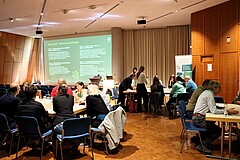
eNaBlS Policy Workshop
29 April 2026 Stuttgart. How can biodiversity and Nature-Based Solutions be more firmly embedded in education, training and professional practice? This question was at the heart of the workshop “Policy Recommendations on Biodiversity and NBS in Education and Practice”, hosted by the Horizon Europe project eNaBlS at the Museum am Löwentor in Stuttgart on 28 April 2026. In the workshop, biodiversity was understood in a broad sense: the diversity of species, genetic diversity within species, and the diversity of habitats and ecosystems. Nature-Based Solutions, often abbreviated as NBS, are measures that build on ecosystems and natural processes. They address societal challenges such as climate adaptation, water regulation and heat mitigation while also benefiting biodiversity.
The workshop made clear that a measure is not automatically an NBS simply because it looks “green”. What matters is whether it is ecologically effective, locally appropriate, viable in the long term and meaningfully embedded in educational or practical contexts. “With eNaBlS, we want to develop recommendations from experiences in education, policy and practice that go beyond individual projects,” said Dr. Ann-Catrin Fender, Project Coordinator of eNaBlS. “The workshop showed that it is not only about new materials. It is about structural integration: in curricula, in qualification programmes, in responsibilities and in cooperation between educational institutions, public administration and practice.” Biodiversity as a question of judgement and responsibility Prof. Dr. Thomas Potthast, Professor of Ethics, Theory and History of the Biosciences and Director of the Ethics Centre at the University of Tübingen, provided the ethical framework for education. In his presentation “Biodiversity and NBS as part of Education for Sustainable Development”, he situated biodiversity and NBS within Education for Sustainable Development, or ESD, the 2030 Agenda for Sustainable Development and the 17 United Nations Sustainable Development Goals, or SDGs. “Biodiversity and Nature-Based Solutions in Education for Sustainable Development are not only knowledge content; they are also connected with questions of justification, prioritization, and balancing,” said Potthast. “Learners must be able to assess which aspects of biodiversity are relevant in a specific place, which Nature-Based Solution fits which problem, and what knowledge is needed in the respective educational context.
Planning for biodiversity from the outset
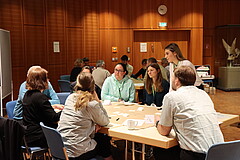
eNaBlS Policy Workshop
How concrete such questions become in implementation was shown by Dipl.-Ing. Architect Marco Tschöp from the City of Stuttgart using the example of the Bildungshaus NeckarPark in Stuttgart-Bad Cannstatt. The project combines a school, day-care centre, adult education centre, sports hall and outdoor facilities. Measures presented included hybrid timber construction, green façades, full-scale green roofing with photovoltaics, nesting sites for house sparrows, common swifts and bats, bird-strike protection on glass surfaces and outdoor lighting adapted to ecological requirements.
“The Bildungshaus NeckarPark shows that ecological measures should not just be added afterwards,” said Tschöp. “Green facades and roofs, species protection at the building, bird-strike protection and outdoor lighting work best together when they are part of the planning process at an early stage. At the same time, projects like this involve considerable costs and a great deal of planning effort. This is why an integrated planning approach is required from the very beginning.”
Initial results from the thematic tables
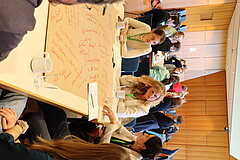
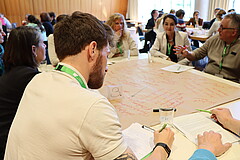
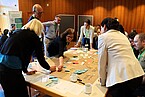
In the subsequent World Café, a moderated exchange format with changing thematic tables, participants discussed four fields: nature-oriented learning spaces and schoolyards, higher education teaching and teacher education, political and administrative framework conditions, and vocational education, continuing education and industry practice.
What became clear was this: biodiversity and NBS need to be more firmly embedded in curricula, study programmes and continuing education structures. Nature-oriented learning spaces such as schoolyards, campus areas and municipal green spaces can provide important learning experiences - provided that planning, maintenance, use and participation are considered together.
At the same time, better coordination, reliable funding and clear responsibilities are needed. In vocational education and professional practice, participants particularly emphasised the need for skilled professionals who can plan, implement, maintain and evaluate NBS - for example in skilled trades, planning, public administration and businesses.
Next steps: a trip to Brussels
The results will now be evaluated by eNaBlS and condensed into national recommendations for Germany. They will then feed into the European project process. Plans include pooling the results from a total of seven workshops in the seven Living Lab countries of the project and presenting the resulting international policy recommendations at a European workshop in Brussels this autumn.
Back to Latest News