KomBioTa at the University of Hohenheim's Open Day [06.07.26]
The KomBioTa team was delighted to welcome many interested visitors to our stand during the University of Hohenheim's Open Day. Throughout the day, people of all ages stopped by to discover the fascinating diversity of insects, amphibians, and other organisms found in our local environment.
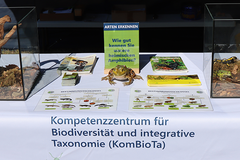
KomBioTa amphibian station ©University of Hohenheim / KomBioTa
One of the highlights was our display of ants collected in the Hohenheim Gardens. Visitors were able to examine the collection and join guided excursions to search for and identify ants outdoors. These activities provided a hands-on introduction to the diversity of ant species and the methods scientists use to study them.
Our amphibian exhibit featured a range of realistic models that visitors could handle while learning how to use an identification key to determine each species. Children especially enjoyed guessing the animals before checking their answers, making the activity both educational and fun.
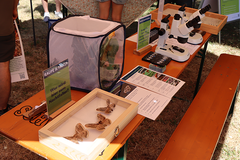
Life cycle of the peacock moth (Saturnia pyria) ©University of Hohenheim / KomBioTa
At our microscopy station, visitors explored a selection of prepared insect specimens under the microscope. They were invited to guess the names of the different insects before comparing their answers with the correct identifications, giving them a closer look at the remarkable structures and diversity of these small but important animals.<o:p></o:p>
Another popular attraction was our display of the peacock moth (Saturnia pyria) life cycle. Visitors could observe live caterpillars alongside eggs, a cocoon, and adult specimens, allowing them to see the complete metamorphosis of this remarkable species.
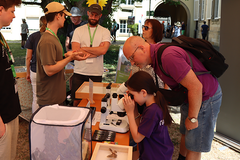
Microscopy station with prepared insect specimens ©University of Hohenheim / KomBioTa
Our bee specialists were also on hand to showcase a collection of wild bees from the local area and beyond. Visitors learned about the impressive diversity of bee species, their unique adaptations, and the essential role they play as pollinators. Throughout the day, our experts shared fascinating facts about bees, ants, caterpillars, insects, and amphibians, answering many questions from curious visitors.
Children had plenty of opportunities to get involved through interactive activities. Our bee "pollination" game invited young visitors to wear bee glasses and antennae while collecting "pollen" using fun rackets. A colouring station featuring insects, along with insect and flower stamps, encouraged creativity, while a giant floor memory game introduced children to a variety of insects.
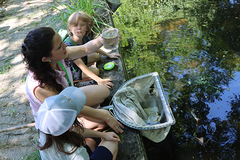
Amphibian tour at the Hohenheim pond with Maggie Eppli; discovery of newt larvae ©University of Hohenheim / KomBioTa
Beyond the exhibits and games, one of the most rewarding aspects of the day was the many conversations we had with visitors about the importance of local biodiversity. We discussed how every species—from tiny insects to flowering plants—plays an essential role in maintaining healthy ecosystems and why protecting biodiversity is so important.<o:p></o:p>
We would like to thank everyone who visited the KomBioTa stand. It was wonderful to share our enthusiasm for biodiversity, meet so many curious learners, and inspire visitors of all ages to take a closer look at the incredible diversity of life around them.
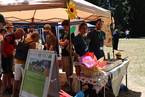
Many visitors at the KomBioTa stand ©University of Hohenheim / KomBioTa

Fun pollination game for children ©University of Hohenheim / KomBioTa
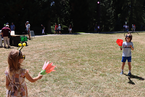
Hands-on activities for children ©University of Hohenheim / KomBioTa
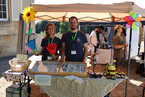
Dr. Simone Cappellari Rabeling and Nadin Kovacevic presenting wild bees ©University of Hohenheim / KomBioTa

Numerous visitors at the KomBioTa stand ©University of Hohenheim / KomBioTa
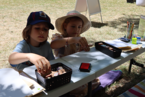
Creative station with insect coloring, stamps, and motifs ©University of Hohenheim / KomBioTa
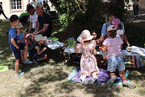
Children’s coloring station at the KomBioTa stand ©University of Hohenheim / KomBioTa
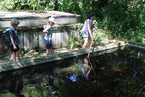
Maggie Eppli and visitors collecting samples with nets ©University of Hohenheim / KomBioTa
Back to Latest News



