New Scientific Paper: Elevational Melanism in East African Honey Bees Involves a Major-Effect Locus [18.11.26]
Marco Mazzoni, Florian Loidolt, Sonja Kersten, Mark Otieno, Henry Njovu, Julius Vincent Lasway, Ricarda Scheiner, Martin Hasselmann
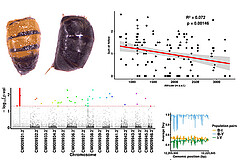
Image taken from https://doi.org/10.1093/gbe/evag260
Abstract taken from https://doi.org/10.1093/gbe/evag260
"Thermal melanism, whereby darker pigmentation occurs in colder environments, is a widespread pattern; yet, its genetic and physiological basis in eusocial insects remains poorly understood. East African honey bees (Apis mellifera) occupy elevational gradients in which highland populations are darker, larger, and more cold-tolerant than lowland conspecifics.
Here, we integrated population genomics, structural variations, and functional genomics to investigate elevational melanism. We sampled, phenotyped, and resequenced 139 workers from five East African mountain systems. A genome-wide association study identified 977 single-nucleotide polymorphisms (SNPs) significantly associated with abdominal pigmentation, with a single peak at the ebony ortholog AmEbony on chromosome 1. Allelic variation at AmEbony formed three genetic clusters tracking a continuous pigmentation gradient, and 77 divergent SNPs (DXY = 1) almost perfectly discriminated dark from light bees.
Two inversions (r7, r9), previously linked to high-elevation adaptation, were detected across additional mountain systems and enriched in dark, highland genomic backgrounds but did not replace AmEbony as the primary pigmentation locus. CRISPR/Cas9 disruption of AmEbony in A. mellifera carnica produced darker adults in a qualitative comparison, supporting a conserved role in pigmentation.
Head RNA-seq and GENIE3 analysis identified recurrent genotype-associated modules involving oxidoreductase activity and odorant binding. Because population structure covaries with elevation and pigmentation, the GWAS supports AmEbony as a major-effect locus but cannot identify causal variants. Similarly, head-expression data identify molecular changes associated with AmEbony disruption but cannot establish whether they contribute to pigmentation or whether naturally segregating East African alleles act through the same pathways."
DOI: doi.org/10.1093/gbe/evag260
Read the full paper here: Elevational Melanism in East African Honey Bees Involves a Major-Effect Locus | Genome Biology and Evolution | Oxford Academic
Marco Mazzoni, Florian Loidolt, Sonja Kersten, Mark Otieno, Henry Njovu, Julius Vincent Lasway, Ricarda Scheiner, Martin Hasselmann, Elevational Melanism in East African Honey Bees Involves a Major-Effect Locus, Genome Biology and Evolution, Volume 18, Issue 10, October 2026, evag260, doi.org/10.1093/gbe/evag260
Back to Latest News

